


In 2013, the United Nations released a report projecting that the global population will reach 9.6 billion by the year 2050. This increase of 2.4 billion people between now and then is already beginning to challenge the world’s agricultural communities to provide adequate food, fuel and fiber while employing sustainable practices that conserve natural resources. The feat becomes more complex when coupled with the increasing demand to grow more bioenergy crops, combat biodiversity declines and regenerate the habitat of agriculturally important insects. Doug Landis, Michigan State University
Research News
Mud matters: reflections from a KBS LTER grad

Each year the KBS LTER program awards two graduate students with summer research fellowships. Here Dustin Kincaid describes the research his summer fellowship supported. Dustin is a Ph.D. student in Steve Hamilton's lab. ~~~~~~~~~~~~~~~~~~~~~~~~~~~~~~~~~~~~~~~~ “ . . . the world is mud-luscious and puddle-wonderful” -ee cummings Mud matters. Especially in shallow water bodies. Or at least I’m convinced it matters—enough to spend most of my 2014 field season hip and often eyeball deep in mud anyways. As water flows across the landscape, interactions with mud, or more
Soil is life – let’s keep it healthy! Reflections from an undergrad researcher
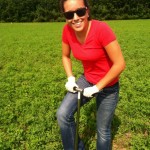
Each summer the KBS LTER supports students to participate in the Research Experiences for Undergraduates (REU) program, funded by the National Science Foundation. This is part of a larger undergraduate research program at KBS. Alessandra Zuniga, a senior at New Mexico State University, writes about her REU experience working with KBS LTER scientists Christine Sprunger and Brendan O'Neill. Coming from the hot arid deserts of the southwest, I never expected to find myself in the middle of lush green Michigan. I was born and raised in the city of Las Cruces, New Mexico and had the privilege to
Fertilizing to help the planet
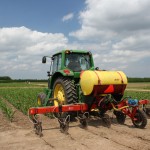
This news piece by KBS LTER volunteer and retired journalist Bill Krasean. Researchers at Michigan State University's Kellogg Biological Station (KBS) Long-term Ecological Research (LTER) program have helped develop a way for farmers to reduce crop-related emissions of a greenhouse gas while potentially lowering fertilizer costs, maintaining crop yields, and getting paid to do so. KBS scientists have developed a program to reduce farm-related emissions of nitrous oxide (N2O), a potent greenhouse gas that also destroys ozone in the stratosphere. Using data collected from Michigan farms,
Insect vacuum on the KBS LTER helps serve as an early warning system
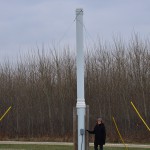
By Bill Krasean, retired journalist and KBS LTER volunteer Every Friday mid-May through mid-October, a staff member at Kellogg Biological Station (KBS) Long-term Ecological Research (LTER) program drives to a tall, narrow pipe on the main experiment site, opens a small door at the base of the tower and extracts a bottle filled with liquid and a cornucopia of insects. The little critters, victims of a strong suction at the top of the pole as they fly by, are shipped to the University of Illinois where Dr. David J. Voegtlin and Dr. Doris Lagos, experts in the identification of aphids,
“Cream of the crop” – LTER research in FUTURES magazine
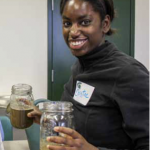
KBS LTER scientists were recently featured in the latest issue of MSU's AgBioResearch FUTURES magazine. The article begins, "Like most students at the Michigan State University (MSU) W. K. Kellogg Biological Station (KBS), which is renowned for advancements in ecological science and evolutionary biology, Christine Sprunger arrived eager to roll up her sleeves and get her hands dirty — literally. “When I took my first soils class as a sophomore at the University of Washington, I just kind of fell in love with the topic,” said Sprunger, now pursuing a dual doctoral degree in crop and soil
CO2 flux towers help assess the sustainability of biofuels

This news piece by KBS LTER volunteer and retired journalist Bill Krasean. If the United States is to develop sustainable biofuels such as cellulosic ethanol as alternatives to grain-based ethanol and the burning of climate-changing fossil fuels, there are still many questions yet to be answered. Key among those questions is where best to grow biofuel crops without sacrificing valuable farm and forestland, says Jiquan Chen, Distinguished University Professor in Environmental Science at the University of Toledo and investigator in the U.S. Dept. of Energy’s (DOE) Great Lakes Bioenergy
Small seedlings help tell a big story: reflections from an undergraduate researcher

Each summer the KBS LTER supports students to participate in the Research Experiences for Undergraduates (REU) program, funded by the National Science Foundation. This is part of a larger REU and intern program at KBS. Caitlyn Byron, a senior at Baldwin Wallace University in Ohio, writes about her REU experience working with KBS LTER scientists Drs. Tim Dickson and Kay Gross. ~~~ It is a beautiful morning in southwest Michigan, so I pause to take it in as I step out of my apartment. The birds are chirping, I can hear boats zooming across Gull Lake, and the sun is peaking through the
It’s not dirt, it’s SOIL: reflections from an undergraduate researcher

Each summer the KBS LTER supports students to participate in the Research Experiences for Undergraduates (REU) program, funded by the National Science Foundation. This is part of a larger REU and intern program at KBS. Monica Cooper, a senior at Kalamazoo College, writes about her REU experience working with KBS LTER scientists Dr. Sarah Emery and Brad Gottshall.~~~~~~~~~~~~~~~~ It wasn't often that I thought about dirt before starting my Research Experiences for Undergraduates (REU) this past June. Since then, I have learned that it’s called soil, never dirt, and I have been learning a bit
KBS LTER research featured in National Geographic
KBS LTER scientists Phil Robertson and Sieglinde Snapp are featured in "Fertilized World," an article examining commercial fertilizer use around the globe, in the May 2013 issue of National Geographic magazine.