


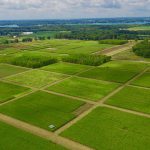
Our congratulations to Bonnie McGill, KBS LTER graduate student, who was recently awarded a National Science Foundation (NSF) Graduate Research Fellowship. We’ve asked Bonnie to write a blog post about her research. Enjoy! The earth and our society face such “gi-normous” problems like climate change, pollution, biodiversity loss, food security—what can a little person like me do about it? This question has been rolling around inside my head for the last 11 years or so, and it seems like my quest is starting to gain more traction. I’ve narrowed my research focus to water quality,
Research News
New tools to measure greenhouse gases
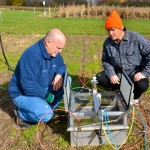
KBS LTER volunteer and retired journalist Bill Krasean reports on new tools we are using to measure greenhouse gases from agricultural lands. His piece was published today in the National LTER Newsletter and reprinted here. When the plants and microbes exhale on the 1,700-acre W. K. Kellogg Biological Station’s hundreds of plots, Sven Bohm, Kevin Kahmark and a team of fellow researchers sniff their breath. Not literally, of course. Rather, using the latest and fastest instruments and software -- much of it based on their own ingenuity -- the team continually samples and analyzes gases
Graduate Student Spotlight – Megan Woltz
Name: J. Megan Woltz Hometown: Afton, NC Degree: Ph.D. Candidate in Entomology & Ecology, Evolutionary Biology, and Behavior, Michigan State University Dissertation advisor: Professor Doug Landis, Department of Entomology, MSU Graduate Research Focus: As a landscape agroecologist, I am primarily interested in understanding how landscape heterogeneity influences the provision of ecosystem services in agroecosystems. In other words, I want to know how the way we design the landscapes around us affects things that we humans care about, such as clean water, wildlife habitat, and air
Nature paper highlights KBS LTER long-term data sets
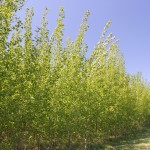
KBS LTER scientists published a paper in the journal Nature today showing how lands that are unsuited for food crops - called marginal lands - can help to meet our nation's alternative energy production goals. By using over 20 years of KBS LTER data, coupled with innovative modeling techniques, the researchers documented that marginal lands can contribute greatly to transportation energy needs while providing climate and conservation benefits. Read more about this research from MSU News and from the National Science Foundation.
KBS LTER and Malawi partnership addresses food security

The W.K Kellogg Biological Station Long-term Ecological Research (KBS LTER) program of Michigan State University (MSU) is partnering with the University of Malawi (UNIMA) in southeast Africa on a new project. The goal is to address Malawi’s agricultural development and food security, two pressing domestic policy issues in a country relying heavily on agriculture. The National Science Foundation (NSF) and the United States Agency for International Development (USAID) cooperated to launch a new funding program; Partnerships for Enhanced Engagement in Research (PEER). As a competitive grant
Undergraduates conduct biofuel sustainability research at KBS
Cait Gallagher and Tamira Vojnar had the unique experience of gaining hands-on research experience as undergraduates at the KBS LTER this summer. Gallagher and Vojnar were part of the Research Experience for Undergraduates (REU) program that brings undergraduate students from across the country to KBS every summer. The ten-week REU program was funded by the Department of Energy through the Great Lakes Bioenergy Research Center (GLBRC). Gallagher, a senior at the University of Illinois at Urbana-Champaign, and Vojnar, a junior at Bowdoin College in Maine, were at KBS from May through early
Guest blogger Bill Krasean on climate

Contributed by Bill Krasean If computer models of changing climate are accurate -- and they get better all the time -- Michigan's weather in less than a century may be similar to Oklahoma's today. With little question summers will be hotter and there will be far fewer -- if any -- bitter cold spells in winter. Although predictions about precipitation are less reliable, there may be longer periods of drought and short, intense periods of heavy rain and snow. That according to Dr. Perry Samson, professor of Atmospheric, Oceanic and Space Sciences at the University of Michigan and noted
Great Lakes farmers could earn credits for cutting greenhouse gas emissions
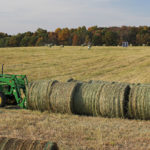
KBS LTER research was featured today in the Great Lakes Echo. "Great Lakes farmers who cut their fertilizer use could help reduce greenhouse gases. And if done through a new emissions trading program, they could get other industries to pay them to do it without harming crop yields." Read the full story here >>.
KBS LTER researchers find way for farmers to participate in carbon markets
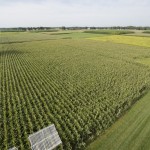
Via MSU News, news.msu.edu EAST LANSING, Mich. — Researchers at Michigan State University have helped develop a way for farmers to participate in carbon markets and get paid to reduce their use of nitrogen fertilizer, which represents one of the largest sources of greenhouse gas emissions from agricultural production. The methodology, which was developed for the American Carbon Registry with support from the Electric Power Research Institute, will allow farmers to participate in carbon markets by creating greenhouse gas offsets by reducing the amount of nitrogen used to fertilize crops.
Climate Change Resources Now Available in Spanish
This spring the KBS LTER has translated a series of climate change fact sheets into Spanish. Julie Doll, KBS LTER Education and Outreach Coordinator, and Claire Layman, MSU Extension Public Policy Specialist, have worked together for three years with the intent on finding ways to engage farmers, scientists, and decision makers in discussions about the relationship between climate change and agriculture. As a result, a series of informational fact sheets have emerged as outreach components of a research projects funded by Project GREEEN, Michigan’s plant agriculture initiative at MSU, and a