


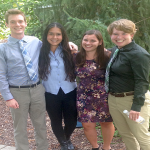
KBS2018 undergraduate summer researcher Emily Lindback is a junior at Franklin and Marshall College. She wrote about her Research Experiences for Undergraduates project working with mentor and LTER researcher Dr. Michael Abraha in the Robertson Lab. Lindback was funded by an NSF REU site award to the Kellogg Biological Station. Driving into Hickory Corners, I first noticed the dense green vegetation, many marshes, huge agricultural plots, and yes, cows. Hickory Corners seemed like a biologist’s dream, the perfect spot for a biological station. I was immediately impressed with the lodging,
Research News
Seeking a more resilient agriculture: the next chapter for the KBS LTER program

Imagine for a moment a Midwestern agricultural landscape in late August that has not seen rain in weeks. Some corn fields remain green, showing no sign of a moisture deficit while other fields have curled leaves, plants starting to yellow. Belowground, microbial communities between the fields are acting differently, too, some biding their time until a pulse of rain puts them in motion while others continue their work. Under the same climate and soils, why is one field more resilient to the stress of drought? What about that field helps it to remain productive? In the midst of global changes,
How can microbes in the soil affect greenhouse gases and mitigate climate change? An LTER researcher hopes to find out

This post was originally featured on Greenboard, the blog of the Environmental Science and Policy Program at Michigan State University on May 31st, 2018. Di Liang is a PhD candidate and LTER grad in Dr. Phil Robertson's lab at MSU's Kellogg Biological Station. ~~~~~~~~~~~ Di Liang is a doctoral student in the Department of Plant, Soil and Microbial Sciences and MSU's Kellogg Biological Station. This summer, he is working to identify the soil microbial sources of the greenhouse gas nitrous oxide. It is his hope that knowing how these microbes contribute to N2O fluxes can offer
Bringing new life to a dead zone problem: Reflections from an LTER researcher

By, Bonnie McGill, PhD candidate and LTER researcher in Professor Steve Hamilton's Lab, W.K Kellogg Biological Station, Michigan State University ~~~~ Nitrate, dead zone, Midwest, agriculture—you know where this is headed. Here I’m going to explain a new project I will soon embark on for my postdoctoral work where I will try to improve our understanding of how voluntary conservation practices on farms in Iowa affect the nitrate concentrations in Iowa streams and rivers. The mammoth amount of previous work, complexity, and controversy around this issue is not lost on me. The issue of
Evolution in the LTER: Reflections from an LTER researcher

Each year the KBS LTER awards full and summer fellowships to MSU graduate students. MSU graduate researcher Susan Magnoli is a PhD student in Jen Lau's lab in the Department of Plant Biology. She wrote about her 2017 KBS LTER summer fellowship project. When you think about studies of evolutionary biology, images of Darwin’s finches, diverse fish communities, or beautiful tropical forests might come to mind. But what about agricultural landscapes? While they at first might not appear to be the most exciting habitats, the farm fields and biofuel crops of the Kellogg
Crops, climate, computers – An eye on complex cropping systems: Reflections from an LTER researcher

Each year the KBS LTER awards full and summer fellowships to MSU graduate students. MSU graduate researcher Prakash Jha is a PhD student in Dr. Amor Ines' lab in the Department of Plant, Soil and Microbial Sciences. He wrote about his 2017 KBS LTER summer fellowship project. The assessment of agricultural sustainability is complex. On the one hand, the increasing production trends are perceived to be critical to meet the increasing demand of food for the growing population. On the other hand, the excessive use of agricultural inputs to increase food production poses a
The little known gas with a big impact

By KBS LTER volunteer Bill Krasean. Dr. Ying Zhang was a visiting researcher in 2017 in Dr. Phil Robertson's lab at the W.K. Kellogg Biological Station in southwest Michigan. ~~~~ Ozone, the simple combination of three oxygen atoms, is both a naturally occurring and human-created gas in the Earth’s atmosphere. Atmospheric ozone is created naturally from gaseous substances emitted by lightning, soil, and vegetation, but it is also formed from pollutants emitted by human activities. Ozone is a mixed bag whose downside is a growing concern worldwide because of its negative
Researchers conduct novel wheat microbiome analysis under four management strategies.
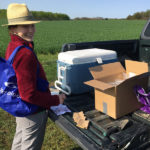
This is an original press release from American Phytopathological Society- Nov 27th, 2017 St. Paul, Minn. (November 2017)--Different crop management strategies can produce various and noticeable effects on a crop and its yield. But what are the effects at the microbial level...not just in the roots but the entire plant? Molecular biologists Kristi Gdanetz and Frances Trail of Michigan State University sought to answer that question, developing a descriptive analysis of the wheat microbiome under four common types of management strategies: conventional, no-till, organic, and reduced
A new view of farmer fields: Using drones for ag sustainability
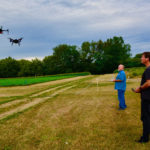
By, Bill Krasean Sven Bohm and Kevin Kahmark are standing in the middle of the Great Lakes Bioenergy Research Center (GLBRC) field site in Hickory Corners, MI, where researchers study the sustainability of different crops grown for use as liquid transportation fuel. Each is holding a small remote control box similar to one used in video games. On the ground nearby are two small black unmanned aerial vehicles, a.k.a. drones. Soon both drones are airborne, humming quietly above the ground and zipping off in selected directions under the eye of the two drone pilots. While both
My KBS summer research experience: Reflections from an undergraduate researcher

KBS undergraduate summer researcher Francisca Donkor is a sophomore at Harris-Stowe State University. She wrote about her Research Experiences for Undergraduates project working with mentor and LTER researcher Heather Kittredge, a PhD student in Sarah Evans' lab at MSU. Francisca was funded by an NSF REU site award to the Kellogg Biological Station. Coming from Harris-Stowe State University, which is comparatively small in size, I knew I had a lot of adjusting and learning to do from day one of my Research Experiences for Undergraduates project at the Kellogg