


 The KBS LTER is located in the agricultural landscape of southwestern Michigan. Credit: Ruben Ulbrich
Research from the Kellogg Biological Station Long Term Ecological Research Program (KBS LTER) provides relevant, science-backed information to meet the practical needs of Michigan farmers, agricultural advisors, conservationists, and policy makers.
We pair data from controlled experiments with on-farm research and farmer knowledge surveys to support the adoption of conservation practices, including no-till, cover crops, reduced chemical inputs, diverse crop rotations, and precision agriculture.
We use decades of data to identify the mechanistic underpinnings of resilience in agricultural systems, and ensure conservation practices are effective and economically viable for farmers.
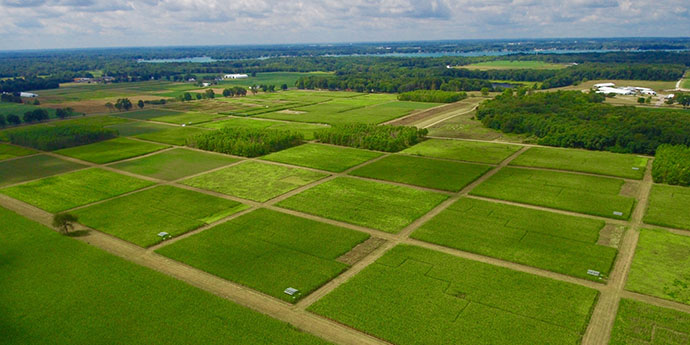
The Main Cropping System Experiment at KBS LTER has been running for almost 40 years, and reflects a variety of intensities of agricultural management, from conventional practice of a corn-soy-wheat rotation with high inputs, to a system with no chemical inputs, perennial systems, and unmanaged fields and forests.
Our long-term use of consistent practices allows us to capture the economic and environmental advantages resulting from conservation practices and management changes. We complement this experiment with large-scale, on-farm, or remotely sensed data to scale up our findings to implications across Midwestern agriculture.
Take a deeper dive into our areas of research:
Regenerative Agriculture
Soil Health
Beneficial Insects
Climate Drivers
Precision Agriculture
Carbon Mitigation
Evolution
Farmer Values
Find out more about research at the KBS LTER:
- View maps and descriptions of the multiple Long-Term Experiments at the KBS LTER.
- Read recent and past Publications from KBS researchers.
- Learn about our Education and Engagement Programs.
- Interested in working or collaborating with the KBS LTER? Get Involved.
- Brush up on almost 40 years of research by reading about the KBS LTER History.