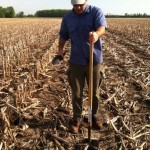
As a follow up to the 2025 Cultivating Resilience Winter Conference, Ottawa Conservation District has partnered up with the Michigan State University Kellogg Biological Station and Shady Side Farm to bring you a field day focused on incorporating prairie strips into your farmland operations and crop fields. Strategically placed native prairie strips in crop fields can increase local pollinator biodiversity, improve local water quality and soil health, and can increase your farm profitability! Attendees will learn from MSU staff and MiSTRIPS farmer, Mike Bronkema from Shady Side Farm, about
Listening first: How KBS is expanding the reach of conservation research
The Kellogg Biological Station (KBS) LTER program has pioneered research in sustainable farming practices and conservation in agricultural landscapes for decades, yet many of these practices are underused on farms. We need a deeper understanding about the barriers faced by farmers when adopting conservation practices, and the stronger connections between existing research and farmer needs. As part of the APEAL Public Engagement with Science (PES) Working Group, Dr. Liz Schultheis, the KBS LTER Outreach & Education Coordinator, along with partners at KBS and MSU
A new approach to soil testing for Michigan farmers: from inputs to indicators of soil health
Each year the KBS LTER program awards two graduate students with summer research fellowships. Here Brendan O'Neill describes the research his summer fellowship supported. Brendan is a Ph.D. student in Tom Schmidt and Phil Robertson's labs. ~~~ My research at the Kellogg Biological Station Long-term Ecological Research (KBS LTER) site has focused on how increasing crop diversity (for example, including cover crops) can enhance soil ecosystem functions while sustaining crop production. Examples of soil ecosystem functions include retaining carbon (C) and nitrogen (N) within
Discussion series gives agricultural community a chance to weigh in on climate change
A series of meetings designed by the Kellogg Biological Station Long-term Ecological Research (KBS LTER) program and Michigan State University (MSU) Extension to deepen the conversation between farmers, scientists, and agricultural professionals on a wide range of issues is proving quite a hit. In a continuing effort that began in 2012, KBS LTER Education & Outreach Coordinator, Dr. Julie Doll, and her colleagues from MSU Extension hosted three discussion events in March 2013 focusing on climate change, alternative energy, and the impacts they may have on Michigan’s agriculture and env


