


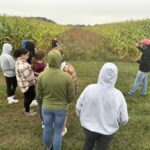
Throughout 2022 and 2023, Melissa Frost, biology and chemistry teacher at Buchanan High School, joined the KBS LTER through our Research Experience for Teacher (RET) program. The NSF-funded RET program partners teachers with scientists to assist in ongoing research in the lab, as well as providing the teacher the opportunity to develop their own research project. Melissa joined Sarah Evan's lab, and worked with scientists Jennifer Jones and Caitlin Broderick. Melissa embraced the RET as a chance to integrate more research and data into her teaching. "Participating in a RET program allowed
The ABC’s – Agriculture, Beneficial Beetles and Conservation: Reflections from an LTER Fellow
Cynthia Fiser is a graduate student in Doug Landis's lab in the Michigan State University Department of Entomology. Her research looks at the impact of perennial prairie strips on the dispersal of ground beetles in row crop agriculture. Rolling hills of wheat, corn and soybean are a beautiful and nostalgic feature of the summer landscape in the Midwest. Here, agriculture is as much a part of the culture as the economy – anyone who attends a county fair would agree! However, the pressure placed on our agricultural landscapes to meet global demands for food, fuel and fiber takes a toll on
Little strips of prairie can go a long way
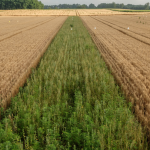
New research out of MSU shows that it is possible to manage farmland to address two challenges simultaneously – protecting biodiversity and maintaining ecosystem services. The key is to strategically place native perennial vegetation within agricultural systems, using the innovative practice of prairie strips. Today, 38% of the landscape in the Midwest is planted in row crop agriculture. “We need to make this land habitable for species for the ecosystem services the increased biodiversity can provide to the farms” said Lindsey Kemmerling, the first author of the MSU-led study
Prairie strip and soil health farm field day to be held in Cassopolis on August 26th
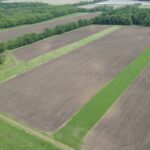
CASSOPOLIS, Michigan— A farm field day centered on prairie strips and soil health will be held on Friday, August 26th (September 2nd rain date) from 1:00- 3:00 p.m. at the Edward Lowe Foundation. The field day will feature speakers including farmers, land managers, and soil scientists who will describe the implementation, management, and soil health benefits associated with on-farm prairie strips. The event is free and open to the whole family and will include a soil pit demonstration, a wagon tour of prairie strips and refreshments. This field day is supported by Michigan State
Prairie strip ecology, art, and advocacy in the LTER: Reflections from an LTER Fellow
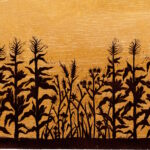
Corinn Rutkoski is a graduate student in Sarah Evan's lab at the Kellogg Biological Station. She is broadly interested in the use of perennials in agricultural systems, science policy, and soil health. Her research path has been propelled by a reciprocal inspiration among ecology, conservation, and creativity. In September 2018, Lisa Schulte Moore was scheduled to give a seminar at KBS titled Prairie strips improve biodiversity and multiple ecosystem services from corn-soybean croplands. At the time, I was a technician in Sarah Evans’ lab at KBS, considering graduate school
Kellogg Biological Station joins multi-state effort to increase the adoption of prairie strips across the Midwest
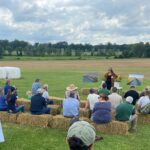
Before there were the gently rolling hills of farmland and forest we see today, southwest Michigan’s landscape included large areas of prairie habitat. Dominated by wildflowers, grasses, and sedges, these habitats were maintained by periodic fires and included oak barrens, dry sand prairies, and wetland prairies. Today, only a few remnants of Michigan’s historical prairies remain on the landscape. Prairie strips, a conservation practice in row crops that protects soil and water while providing habitat for wildlife, are one way to restore these habitats to the
A new perspective – using bioenergy crops to alleviate global warming: Reflections from an LTER fellow

Jinho Lee is a PhD student in the Plant, Soil and Microbial Sciences Department at Michigan State University. He works in the Kravchenko lab with interests in carbon dynamics of soil. Today we are facing one of the biggest environmental challenges that our species has never faced, and one that is caused by our own actions. Since the Industrial Revolution, the worldwide carbon dioxide (CO2) emissions have increased due to use of C-based fossil fuels. This has resulted in global warming. To alleviate global warming and reduce the dependence on fossil fuels, several alternative